
COMPOUND PRIORITISATION
Which compounds hit my target?
Use our AI models to rank candidates for a defined protein target and design a focused experimental follow-up.
Typical outputA compound shortlist, supporting evidence and a validation plan.

INVENTRO.
Our AI models prioritise drug hypotheses. Our laboratory tests them. We bring both together to help oncology teams decide what to advance, retest or stop.
01 / FROM AI TO EVIDENCE
AI can propose more drug hypotheses than a team can test. The bottleneck is deciding which deserve an experiment and establishing whether the predictions hold in a biological model.
RESEARCH / SCOPE
From finding compounds for a target and exploring a compound's targets to investigating combinations and drug responses across tumour types or individual samples. We shape the first study around your question and the available evidence.
Start with computational prioritisation, a standalone laboratory study or an integrated project. The scope follows the question.
AI / PREDICTION
We develop our own AI models to predict molecular targets and biological activity. They rank candidates for experimental follow-up. We also draw on external computational tools where appropriate.
A prediction alone cannot establish how a compound behaves in cells, its toxicity or its clinical efficacy.
LABORATORY / EXPERIMENT
We design experiments to measure compound activity and cellular responses, with methods and controls chosen for the research question.
The evidence applies to the model and conditions tested. An in vitro result does not establish efficacy in patients. Patient-derived ex vivo assays are in development.
SCIENTISTS / INTERPRETATION
Our scientists compare predictions with observations, assess uncertainty and recommend what to advance, retest or stop.
The recommendation comes from scientific review, not an automated AI verdict. Your team makes the research decision.
Schematic research workflow. Microscopy from the Inventro image archive.
Seeing both lets us identify where models hold and where they fail, then refine the next hypothesis or experiment. This is the value of combining AI and experimental biology around one research question.
02 / WHAT WE DO
For biotech, drug discovery and AI teams that need biological evidence. Start with a computational question, a laboratory study or a project that connects both.
COMPOUND PRIORITISATION
Use our AI models to rank candidates for a defined protein target and design a focused experimental follow-up.
Typical outputA compound shortlist, supporting evidence and a validation plan.
TARGET EXPLORATION
Investigate possible protein targets using Inventro AI predictions, activity data and the scientific literature.
Typical outputRanked target hypotheses, their limitations and experiments to test them.
COMBINATION RESEARCH
Explore potential combination partners and design experiments to assess whether their combined effects are synergistic.
Typical outputCombination hypotheses and a plan for experimental testing.
TUMOUR RESPONSE
Investigate tumour contexts that may be sensitive to a compound, using available evidence and relevant preclinical models.
Typical outputResponse hypotheses and a model-selection plan for experimental follow-up.
SAMPLE RESPONSE
Explore responses in patient-derived material through our ex vivo programme.
Typical outputA proposed sample-specific study, subject to model validation and sample availability.
These questions guide our research. We agree feasibility and scope for each project. This work supports preclinical research, not treatment decisions.
How we do it03 / HOW WE DO IT
Computational predictions and laboratory measurements address the same research question. We agree the scope with you, from a focused shortlist to experimental evidence for a preclinical decision.
AI / COMPUTATIONAL APPROACHES
Start with a protein target or a compound. Our in-house AI models predict target interactions and bioactivity to identify hypotheses worth testing.
We combine our predictions with literature and databases, adding external structure- or affinity-prediction tools where they help answer the question. Our scientists assess the evidence and decide what is worth testing.
Candidate space

Models and evidence
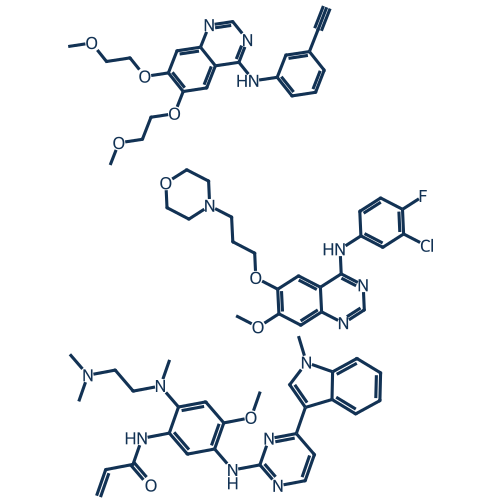
Ranked hypotheses
AI-prioritised compounds tested in two CLK1 biochemical studies. Study-specific hit rates, not overall model accuracy.
We evaluate predictions against drug-target relationships published after the historical data used to fit the model, alongside experimental reference data.
Computational-only work delivers a ranked shortlist and a validation plan.
Explore the AI research demoBIOLOGY / EXPERIMENTAL APPROACHES
Biochemical assays, cellular models and quantitative imaging test selected hypotheses. We choose the measurements and controls to match the question.
Measure compound activity, cell viability, cytotoxicity and apoptosis, with functional readouts for a closer look at the response.
Measure individual cells, distinguish populations and follow changes in proliferation, protein localisation and response over time.
A single viability result can hide different cellular responses. We are developing assays on patient-derived tumour material to distinguish how tumour cells and surrounding cell populations respond to the same compound.

Patient material extraction
Proprietary processing protocols
Sequential microscopy imaging
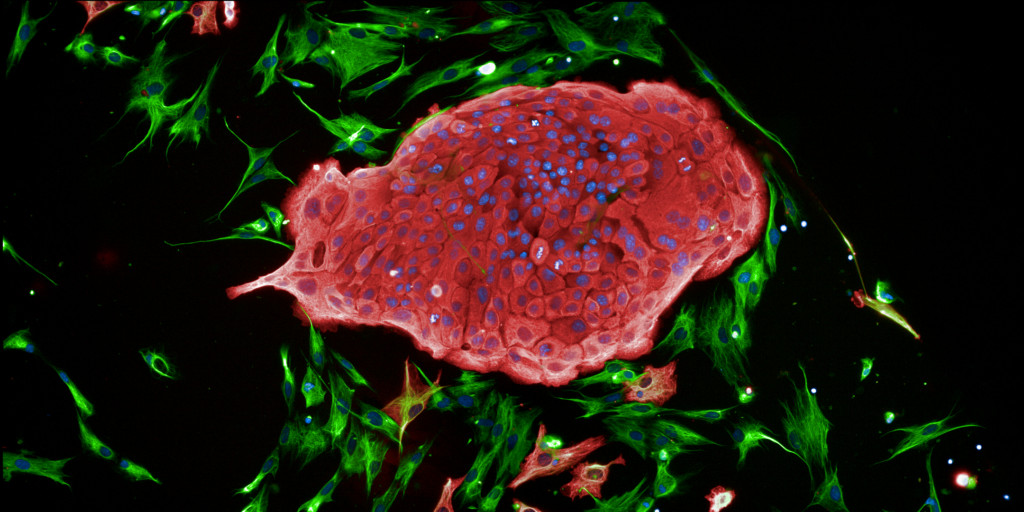
Multiple cellular features, measured within their biological context.
Images from Inventro in-house imaging experiments.
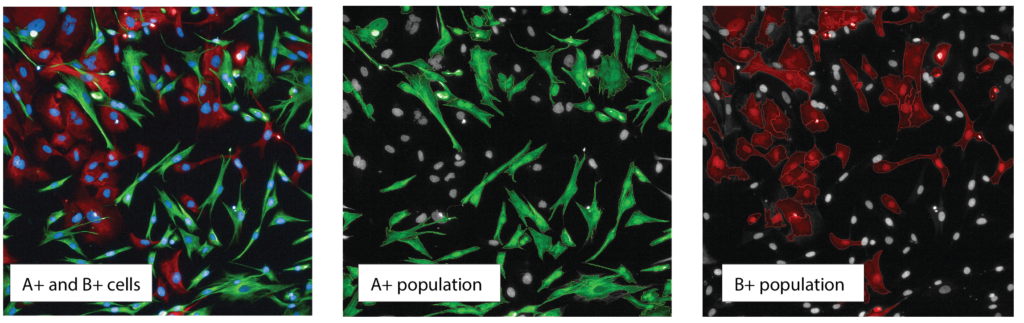
Identify each population before measuring its response.
Separate co-culture method example. A+/B+ are marker labels, not identities assigned to the ex vivo images.
Original figure
Different cell populations. Different compound responses.
Experimental data: normalised cell counts. Separate study from the A+/B+ example.
Original figureWhat you receive
Experimental evidence, interpreted for your next research decision.
For projects that include laboratory validation. Computational-only prioritisation remains a separate deliverable.
A recommendation on what to advance, retest or stop, supported by the evidence gathered.
An interpreted report explaining how far to trust the findings and what remains unresolved.
A recommended next step to address the uncertainty that matters to your decision.
Study-specific data, such as dose-response measurements or cell-population response analyses, with documented methods, controls and scientific interpretation. The contents are agreed before work begins.
04 / OUR TEAM
Our team brings together expertise in medicine, systems biology, molecular modeling and experimental research.
Chief Executive Officer
MD and MBA with experience in healthcare, medical technology and biotechnology ventures.
Professional profileChief Scientific Officer
Systems biologist trained in Warsaw, Warwick and at Imperial College London. Established the Inventro laboratory.
Professional profileHead of AI
Medical doctor with a DSc in physics from the University of Warsaw. Specializes in computer-aided drug design and molecular modeling.
Head of Biology
PhD in biological sciences from the Nencki Institute, Polish Academy of Sciences. Designs and runs in vitro assays in cellular models.
Professional profileFinance & Business Development
Entrepreneur and strategic advisor with more than 20 years of experience in finance and technology.
LET’S TALK SCIENCE
Know what merits the next experiment before committing to the next stage of development. Tell us about your target, compound or research question.
contact@inventro.coDiscuss the decision, available data and feasibility.
Confirm scope, deliverables, timing and price before work begins.
Review the results together. Each further stage is commissioned separately.