
HIGH-CONTENT IMAGING
Multiplex protein measurements
How does a treatment change protein signals within cells?
Iterative immunofluorescence combines multiple protein readouts in the same sample while retaining cellular context. Single-cell measurements reveal response distributions that a bulk average can obscure.
EXPERIMENTAL DATA
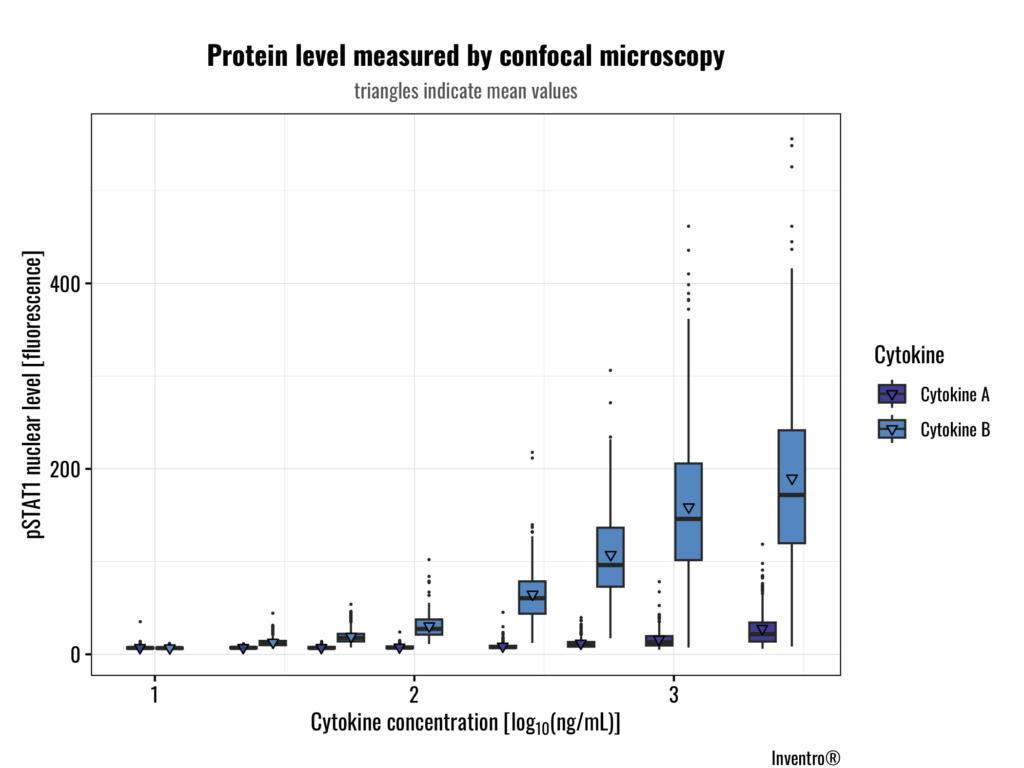
This figure illustrates one protein readout, pSTAT1. It is not a multi-marker panel or a demonstration of the full multiplex workflow.
The method
Stain and image
Label selected proteins with antibodies and acquire fluorescence images. Segment cells and relevant compartments, such as the nucleus.
Repeat across markers
In 4i, antibodies are eluted between imaging rounds. In CycIF, fluorophores are inactivated before further staining and imaging rounds.
Integrate readouts
Align measurements across rounds to assemble per-cell protein profiles. Compare marker intensities and response distributions between conditions.
Reading the results
Single-cell protein-intensity measurements, compartment-specific signals and, for multiplex panels, per-cell marker matrices and pathway-oriented profiles.
Interpretation
Fluorescence is a relative readout influenced by antibody specificity, staining and imaging conditions. A change in one marker does not, by itself, establish a complete mechanism of action.
Study design
The antibody panel, sample preparation and number of imaging rounds depend on marker compatibility and the study objective. Appropriate controls and assay validation are required for each panel.